Thursday, February 23, 2006

Two Sides of Missions

This weekend we had a marathon “Field Leadership Team” set of meetings in Kosovo.  These are the meetings of our field’s team leaders and our boss and assistant boss.  The February meeting is particularly grueling because it’s when we hammer through the following year’s budgets, assign the mission fleet of vehicles, and do a lot of other plain hard work that makes the machine work.


But Sunday night we heard that three people had accepted Christ that night in our church service.  Two of them are fathers and “heads-of-households,” which is critically important in our context.  I was so incredibly pumped up. 


When people think of missionaries they think of preachers and prayers and other stuff.  They probably don’t think of logisticians, budget-eers, strategists and so forth.  Missionaries are all those things.

Thursday, February 16, 2006

it's the little things in life...

So I’m at the bank today, waiting to do some mission business.  I’m standing in line…quite a long line…waiting to submit my paper work and make a withdrawal.  I’m standing there with Reilly, who is growing impatient while Naim waits for me in what might charitably be called a “lobby.”  While I’m standing there telling Reilly, for the fourth time, that no, we are not finished yet I notice a mummer ripple through the line. 


Three men walk in, greet the security guard amiably and walk past the front of the line right to a teller who is helping someone else.  The leader is an older man in a dark brown leather jacket.  The two guys with him are obviously “muscle.”  Both are wearing leather jackets, on is very, very large and has pleasant face.  The other is very, very sharp and rarely takes his eyes off the door.  They intentionally flank the boss and all three regularly look up from what they are doing to scan the crowd.  After a little while they finished their business and left the way they came in, quickly.   About fifteen minutes later we left the bank, our business finished too.  I wondered who the three men were, and how they so casually disrupted the lives of so many who were waiting (relatively) patiently.


One more reminder that I’m not in Kansas any more.


Sunday, February 12, 2006

A young woman met Jesus today

Today we were up to church in Prishtina.  We haven’t made our way up there for several weeks and it was good to see all our friends and pastor Fehmi.  There were a number of news faces in the congregation, including one young lady who came with our friend F.  At the end of the service, after a great message on the love of God, F raised her hand.  She’d been whispering to her friend who had made it known that she wanted to meet Jesus today.  Fehmi invited the two of them to come to the front where he led the young lady to Christ, praying what we commonly call, “the sinner’s prayer.”

It was a great way to end the day.  People bringing their friends to meet the Master is definitely a New Testament model and one that is always fun to watch.  I don’t give you this young ladies name, but please be praying for one new light in one church in Prishtina.  Another child has come back to her Maker.

Thursday, February 02, 2006

...in other words, you stink.

The life of a missionary is one of constant humiliation.  Not humilation in the sense of shame or guilt but of being humbled.  I just got back from our weekly men’s Bible study.  I was excited because for we had one of those rare instances when a fully grown, head-of-household, visiting man came to our Bible study.  This is pretty significant in our context.  We’re studying our way through the book of Daniel because there are so many key lessons for men there…until we get to all the weird vision stuff anyway.

            So I poured my heart out of all the clever and insiteful things I could think of from Daniel chapter 5.  I stretched my poor Albanian language skills into the far abstract…and was corrected a number of times by our adult regulars.  Finally, we were finished.  Our visitor said he had enjoyed it, that it had been very interesting, etc.

            Then one of our most respected men spoke up.  “Oh, you should come on Sunday when Pastor Femi is preaching.”  It’s MUCH more interesting.


Oh well.  That’s the life of a missionary.

Monday, January 30, 2006

At Rugova's graveside

Last night Melissa and I went to Prishtina for dinner and a night out for Melissa’s birthday.  After dinner we headed to a favoriate spot for dessert and on our way decided we would try to find President Rugova’s grave.  We had all seen it on TV; one news article said that a million people came to Prishtina last week to pay their respects.  That’s amazing considering that Kosova only has about 2.5 million inhabitants.

We’d all heard contraditory information about the location of the cemetary, but at last heard that it was near his house in a park we had passed by daily when we lived in Prishtina.  We found the location easily enough, brightly lit by tall towers, a newly lit walkway flanked by 61 newly planted trees to commemorate his life.  At the grave site were two dark-coated men and a police car to watch over the location.  Ringing the graveside were scores of flower wreaths from various places and people.  One was from the German branch of Rugova’s political party.  Others were from various nations.  The State of Isreal, the Chech Republic, Poland and others.  Situated prominantly, directly behind the grave, was the wreath from the Government of the United States of America.

I was drawn to it, filled perhaps with childhood fantasies about the Government of the United States of America.  I say fantasies because nothing is ever as good as it appears on TV.  I expected our government to provide a beautiful wreath, perhaps better than the others…larger or more beautiful in some way.  In reality, there were wreaths that were bigger, and more beautiful.  The banner that held the label had already begun to come apart, barely two days after the funeral.  It was not what I expected,cheap red ribbon drooping lazily over the large black word, “America.”

And so I was once again touched by the reaily of Rugova’s death.  Death appears so final from this side of eternity.  And few of those one million mourners will ever have any hope for something beyond the grave.   For them, it is the end.


Sunday, January 29, 2006

Quote of the Day

I saw a great quote today. Of course, sometimes quote like this are used by folks who can't get along with others just so they create problems and be affirmed by it. :)

"We should not expect good work to be acknowledged; and where it is, we should not expect it to be welcomed. Rather, the strength of a creative impulse is measured by the strength of opposition it meets."--Robert Frist, via Scobleizer - Microsoft Geek Blogger

Saturday, January 28, 2006

International Day of Prayer and Fasting for Kosova

This is a little long, but it’s important.  The following comes from the newly formed national church organization in Kosova.  We are trying to call people to a day of fasting and prayer on January 31st.  There are a number of very important prayer requests, especially for the new law that I mentioned here.


REMEMEBER KOSOVA


During the Kosovo crisis in 1999 Kosova was in the main news worldwide because of the war and tragedy. It was then that we asked our brothers and sisters around the world to join us for an International Day of Prayer and Fasting for Kosova on the 31st of January 1999. Now after 7 years many things have changed, but still there is a need for lots of prayer...

The Christians of Kosova need your prayers and support!  Please join us in praying for:

          Spiritually, Kosova contains about 2 million predominantly Muslim Albanians and over one hundred thousand Serbs who are Orthodox Christians. The Protestant-Evangelical Christian church in Kosova is very small and under pressure.

          Many Kosovar Albanians have a hatred of Christianity as they were oppressed by the former Serbian (Orthodox Christian) regime.  Albanians believe that whatever your religion is, to change it is a shameful thing.  Muslims that accept Christ as their Saviour will bring shame on their families and face persecution from their community.

          Politically, Kosova was a self-governing province of Yugoslavia enjoying significant autonomy before Slobodan Milosevic came to power in 1987. This autonomy was removed and Kosovo was made a province under the direct rule of Serbia. Even though the majority of the population of Kosovo was Albanian, the Serbian minority held most of the important positions in law enforcement and administration.

          In 1998-1999, thousands of Albanians were driven out of Kosova by Serbian military forces. NATO subsequently authorized air strikes and by summer 1999 the Serbian military was forced to retreat.

          On the 10th of June 1999, with resolution 1244, the UN Security Council authorized the establishment of an interim international civilian administration in Kosova. Subsequently, the UN administration has given back substantial autonomy to the people of Kosovo and the last stage of the UN Mission's mandate in Kosovo is to finalize Kosova's future political status.  This future status is now the subject of intense diplomatic activity.

          Economically, the challenges Kosova faces today are huge. The situation is serious. Following the economic crisis in the 1980s and 1990s, the economy in the post-war period has depended overwhelmingly on remittances from family members working aboard sending money home, as well as international assistance. Relative to the present size of Kosovo economy, the public sector is unsustainably large, and the continuing decline in international aid means that urgent investment is needed. Present rates of unemployment and underemployment are at crisis levels.

         The current system of government in Kosovo is very new and untested. Many new laws and regulations have been passed already under the scrutiny of the UN Administration.

         However, the Provisional Government of Kosovo is proposing to enact a new Law on Religion that will require the Protestant Church to register as a religious community. A condition is being placed on registration that will require a stated minimum number of 2,000 Protestant Christians to declare themselves as such in a forthcoming census. However, many are afraid of the consequences if they publicly declare that they are Christians. It will be difficult for the church to reach the required number and comply. The church in Kosova is having a hard time because of disagreements with different institutions about our position. There are some serious attempts to isolate and consider the Evangelical Church in Kosova as a "new sect".

          Please pray that God will intervene and that this hurdle will be overcome. 

 As we write this letter Kosova is in 15 days of mourning as last week President Ibrahim Rugova died. He was a leader and an incredible president for 16 years. Many internationals have called him the Father of the Kosovar Nation. People are concerned that his death can cause troubles in Kosova. He has been known for his pro-Christian attitude and he was always willing to meet with church representatives at all times. Over five Hundred thousand people came to Prishtina to pay tribute to the “man of independence” for Kosova


Please pray for a new President that will be elected next week, and that he will continue to support Christianity.


We once again ask all of you, brothers and sisters, to join Christians in Kosova on January 31st on an International Day of Prayer and Fasting, to remember Kosova in your prayers in this crucial time.

 
    1. For our political leaders, especially now after the death of our President. Pray that the new president will be a God chosen person.   

            
    2. Pray for negotiations regarding the final status of Kosova that are planned to begin soon. There is a huge difference between what Albanians and Serbs want so lets pray that God will provide the best solution for this land.

    3. Let's pray that regarding the political solutions Kosova will remain a free country for Christian work and witness.

    4. Let us pray that whatever the final law on religious freedoms  would be it will enable us to freely exercise our faith and worship Jesus Christ our Lord and Saviour.
 
    5. Recently we have experienced a media campaign against our community. Let us pray for God's protection and His strengthening to all of us, Pastors, Leaders, missionaries and all Christian believers in our country.
  
   6. Please pray for our witness and evangelism of our churches. Pray that 2006 will be a year of spiritual awakening and growth .

   7. Pray for our discipleship ministries and for God to multiply Kosovan leaders in our churches. Pray for new pastors, new preachers, new worship leaders, evangelists, etc, among Kosovar Christians.

   8. Pray for unity among Christians and churches in our country. We want to be one in God. Pray that we will have God's unity that will
show His glory.

   9. Pray for the Council of Ministers of the Kosova Protestant Evangelical Church (KPEC), that God will give us wisdom and guidance as we serve our Christian comunity. Please pray that God will keep us humble and that we may seek Him above anything else.

   10. Please pray for KPEC that it will be a real Body of Christ in Kosova and not just an organization. Please pray that everyone within KPEC will experience God' blessings as a family of God.

Together in Christ,
Pastor Bekim
Chairman of the Council of Ministers of KPEC

  Kisha Protestante Ungjillore ne Kosove

The Protestant Evangelical Church in Kosova
 
www.kishaprotestante.org


Friday, January 27, 2006

Who needs electricity...ya, sure

The electricity has been terrible this week!  It’s been going on and off randomly…and staying off for long periods.  Back when we first got here it went off and on like clockwork…mostly.  You could rely on carefully scheduled power outages to screw up your day.  Now, however, you never know when it’s going to go out…or come back on.  I got up about 6:20 today to find the power out and the house cold.  Heating water for coffee on the stove isn’t a big deal, but it’s not as convenient as our ubiquitous hot water heater.  That baby goes from stone cold to boiling in about 30 seconds…when you have power.  Fortunately our wood stove still had hot coals in it.  It went from hot to blazing furnace in about five minutes…a relief when the temps are FAR below zero like they have been this week.

It’s not really a big deal, but its’ a little annoying.  What’s funny is that KEK, the Kosova Electrik Korporation siad that this week all of Kosova would have power rationing of only one hour off, five hours on…during the time of mourning for Rugova.  Watch out, whenever KEK makes a promise of more power you can forget about it.

We’re pretty accustomed to power outages at this point. They’re a daily occurrence.  A guy just has to keep his laptop batteries charged up and he’s in business.  But it is tough when your internet is down, and you can’t read the morning papers with your instant coffee!  It’s such a tough life ;)

Tuesday, January 24, 2006

Giving condolences at the local party office


From his site

When someone
dies in Kosovo friends and family rally round the family of the bereaved to “ngushlloj”
them, to give condolences. When the first President of Kosova dies, everyone is "ngushlloj-ing" each other. While Rugova's body lies in state at the parliament building, thousands wait outside in the bitter January cold for their change to pay their respects.

Today Naim and I went to give our condolences at the local poltical party office of the fallen President. After arriving we entered a very, very solemn room, complete with a large picture of President Rugova and many, many flowers. Perhaps fifty people ringed the room and as we entered all eyes turned to us. We greated people around, approached Rugova's picture and paid our respects there. Then we sat for a moment and expressed our condolences on behalf of the Protestant Community in Gjilan. Naim saw many people he knew in the room, I saw only a couple.

I'm writing a lot about Rugova's passing lately. I hope it isn't becoming tiring to my many in cheek readers. It's a very, very big deal here, so it's a big deal to me too.

New Law on Religion, Take Two

I spent several hours in a very intresting meeting in Pristhina yesterday.  It was a meeting of all the American Missionaries in Kosovo to talk about the latest amendments to last year’s law on religion.  Last year (2005) the Governement of Kosovo spent a good bit of time drafting a law on religion that would,hopefully, protect the interests of the various religious communities here.  That law was passed by the parliament in 4Q of 2005, I believe.  Among other things it stated that to be a “religious community one had to have at least 500 members.  Soon new legislation will be introduced that changes that minimum number to 2000 members.  The status conveyed by this law will greatly influence a fellowships ability to do evangelism, to own property, to have the full protection of the law, etc.

We talked about the growing resistence to the Protestant community here yesterday.  Unlike the previous law on religion, there was no Protestant (Evangelical) representation at these latest talks.  The actual text of the law is also being kept private.  That is, copies are not being made available to the public or the press.  Third, the US Office in Kosovo, the US Governments official representative, is more and more ignoring the protestant community here.

Please pray for God’s direction relative to this latest law.  In an upcoming census citizens will be asked to declare which religious group they belong to on the census document.  My fear is that many will be too afraid to speak the truth.  Too much blood has been shed here in the name of religion over the last several hundred years.  Please pray that God’s people will stand up and (literally) be counted.

I’m also learning a lot about how different nations view law and freedom.  In the US we generally believe that we have the freedom to do what we want unless there is a law specifically against it.  In many other countries the philosophy is that you may do nothing except that which the law specifically allows.  It makes a huge difference, especially when it comes to a minority belief among a skeptical majority.

Sunday, January 22, 2006

Rugova's passing

I just got back from trying to drop my daughter off to preschool.  We were met by a teacher, accouning that school is closed today because it’s a “black day,” which means a day of mourning.  I don’t think the full implicatons of Rugova’s passing are going to hit people for a number of days.  We had an interesting time at church last night as people shared their reations to Rugova’s death.  It’s creating a great deal of uncertainty, I think.  I haven’t polled large numbers of people, and Rugova wasn’t univesally loved, but he had stature that no current politician seems to hold.  He was known as a man of peace, an intellectual that has been called “Kosova’s Ghandi.”

Men who have paid the price for non-violence are not common in the Balkans.  The popular tradition calls for men of action, men of high adventure and, sometimes, men of bloodshed.  Time will tell, but I am afraid that Kosovo has lost something greater than its president. 

FW: Flags fly at half staff on top of Kosovo's Preside...

From KosovaReport
 

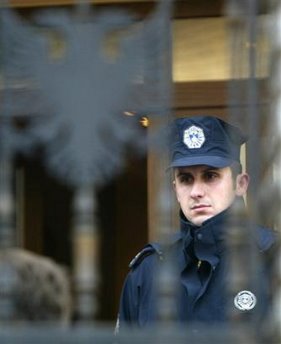
Flags fly at half staff on top of Kosovo's President Ibrahim Rugova's residence as Kosovo Police officers guard the building in Kosovo's capital Pristina on Saturday, Jan 21, 2006.

In The News: A Kosovo police officer stands guard at President ...

From Kosovareport

  A Kosovo police officer stands guard at President Ibrahim Rugova's residence as officials arrive to express their condolences in Pristina on Saturday, Jan 21, 2006. Rugova who had been suffering from lung cancer, died on Saturday, Jan. 21, 2006 according to officials. Rugova had been at the forefront of ethnic Albanian demand for independence from Serbia since the early 1990s, when he started leading a nonviolent movement against the policies of Slobodan Milosevic, then president of Yugoslavia. (AP Photo / Visar Kryeziu)

Saturday, January 21, 2006

Kosovo President Rugova dies at 61

We were at a birthday part in Pristhina today when we got the news.  Everyone was stunned.  While Rugova wasn's universally loved, perhaps, he held a special place in everyone's hearts.  We're expecially sad to hear that he's passed over since Kosovo is on the brink of final status talks.  Not to over-spiritualize it, but we almost feel like there is something Moses-like about him.  He led non-violent protests for years, squaring off against the authorities from Belgrade.  And now on the brink final status, he remained outside the "promised land," unable to enter that for which he struggled for so long.
Recently there was renewed speculation that he had become a Catholic in recent years, trying to recover the faith of his Illyrian forefathers.  I can only hope that he met the Savior on his journey and that he now lives with those same forefathers that the Apostle Paul mentions in Romans 15.19.  Rest in peace, President Rugova.

CNN.com - Kosovo President Rugova dies at 61 - Jan 21, 2006
CNN) -- Kosovo President Ibrahim Rugova, the literary scholar turned politician who was the symbol of the fight for Kosovar self-rule, died Saturday after battling lung cancer, officials said. He was 61.


New Visitors in Gjilan

We've got new visitors in town.  Almost every day we see patrols of US soldiers walking up and down the streets of Gjilan.  They are always friendly and almost always surprised to hear that there are other Americans in town. 

CAMP BONDSTEEL, Kosovo — For the first time in more than six decades, the colors of the 36th Infantry Division are flying again in Europe.

The Texas National Guard unit, which fought in Italy during World War II, took over Kosovo Force’s Multi-National Brigade (East) in a transfer of authority ceremony Wednesday. The 36th assumes responsibility of the U.S. sector of the province from the 40th Infantry Division from California and will be carrying out peacekeeping duties for the next year

Stars & Stripes

Monday, January 16, 2006

In the News: "No alternative to Kosovo indenpendence" - OSCE Official

So far there has been a lot of smoke and little fire to the final status talks.  That’s probably to be expected but the news is not without a lot of speculation.  So far the two options on the table seem to be completely and total independence for Kosovo….or not.  Who knows what will come out of these and who knows how the people will react.  One thing is almost certain: a large group of Albanians will be unhappy with the outcome. 

Text of report by "jdc" entitled "According to unofficial sources, Kosovo will gain independence" carried by Belgian newspaper De Standaard website on 16 January
Nobody wanted to give an official confirmation at last week's OSCE conference in Vienna, but unofficial well-informed observers are saying with surprising firmness that "we have no alternative to Kosovo's independence".
The issue is very sensitive. Officially, Kosovo is still a province of Serbia that the United Nations has been governing since the 1999 war. By the middle of this year, however, a decision on its "definitive status" is due. The Kosovo Albanians, i.e. 90 per cent of the population, want independence. The Kosovo Serbs, the remaining 10 per cent who live mainly in the north, want to stay with Belgrade.
Last Friday [13 January] in Vienna, [Belgian Foreign] Minister [and OSCE Duty President] De Gucht met former Finnish President Martti Ahtisaari, the UN envoy who is leading the status talks. After the meeting, De Gucht declined to confirm or deny that independence - which will most likely be restricted in the initial stage - is the most plausible option because of the overly sensitive nature of the issue.
"Whatever happens, we will have to strive laboriously for a balanced solution," De Gucht said. "There are many minorities; we will have to maintain close contacts with Belgrade; and we will have to conduct the talks on the possible decentralization of power in Kosovo."
"Not all proposals are equally valuable. A Greek professor suggested granting Kosovo's minorities the same status as Mount Athos (a republic of monks in Greece - De Standaard editor's note), including their own legal system. In my opinion, this would be unfeasible in Kosovo."
In addition, the fear exists that the Kosovo Serbs will want to annex their part of the country to Serbia.

Friday, January 06, 2006

Mladic still taking a pension?


    It is revelations like this one that make the people of Kosovo suspicious of the government in Belgrade.  The government of Serbia & Montenegro (former Yugoslavia) have been paying Mladic pension payments up until last November.  Can you believe this?  He's been a fugitive since the war in Bosnia and is wanted on two charges of genocide for the slaughter of 8,000 Muslims in Srebrenica.  Keep the checks coming though.
    And the international media/community continues to frequently paint the Albanians with a black brush.

International News Article | Reuters.com

Fugitive Mladic drew army pension until weeks ago
Tue Jan 3, 2006 7:34 AM ET169 

BELGRADE (Reuters) - Bosnia Serb war crimes fugitive Ratko Mladic drew his army general's pension in Serbia up until November last year while on the run from international justice, according to government ministers.

An investigation had revealed that Mladic's wife, son and two Army officers, one retired and one still active, had been authorized to pick up the money in 2002, when Mladic dropped out of sight to avoid arrest, they said.


More speculation about Rugova's faith

Speculation has abounded recently about the “true” faith of Kosovo President Ibrahim Rugova.  I heard someone last week state, in fact, that he announced his Christian faith on TV on Christmas day.  Since I didn’t hear it anywhere else, I assumed it was just a rumor.  Some people in the West might feel very good if Rugova had, in fact, converted.   But you have to remember that in the Balkans, all religion is about identity and politics.  To talk about “faith” here is to talk about ethnic identity and national agenda. 


I do hope that Rugova meets the Savior soon, if he hasn’t already.  But no one around here will see it for what it might be.  It will be interpreted politically.  Unfortunately, this is largely the Church’s fault.  It was the universal Christian church that split in 1054 in the Great Schism. The line of that fracture went straight up through the Balkans.  As a result, families, clans and tribes were split in deciding who would follow Rome (Catholic) and who would follow Byzantium (Orthodox).  Nothing simple here, especially a single soul’s search for truth.


http://www.adnki.com/index_2Level.php?cat=Politics&loid=8.0.246430378&par=0

KOSOVO: RELIGIOUS INTRIGUE AS RUGOVA DECLINES

Pristina, 5 Dec. (AKI) - Kosovo president Ibrahim Rugova’s religious beliefs have become the subject of wild speculation as the health of the 61 year old, who is spearheading Kosovo's independence drive, worsens. Rugova has been hospitalised since last week with lung cancer and there have been widespread rumours in Pristina that he has told close associates he wants to be buried as a Catholic. About 95 per cent of Kosovo's ethnic Albanians are Muslims and the matter of Rugova’s religion has until now never been raised.

Kosovo political analyst Nexhmedin Spahiu says that Rugova was a Muslim, though he never visited a mosque, and had strong Catholic inclinations. “Personally, I believe that Rugova has converted to Catholicism, but there is not a single proof for it,” Spahiu told Belgrade daily Kurir……


Friday, December 23, 2005

In the News: Blood Feuds

Here’s a fascinating article about modern blood feuds in Kosovo.  We hear about these feuds regularly, but not with this much detail and color.  At the same time, you shouldn’t get the impression that these are a daily occurrence.  If you want to read a fascinating, fictional account of blood feuds in Albania, check out a great book called Broken April, by Ismail Kadare.


http://www.mg.co.za/articlePage.aspx?articleid=259782&area=/insight/insight__international/

"Ancient blood feud grips part of Kosovo

Ismet Hajdari | Petrove, Serbia-Montenegro       

22 December 2005 11:59

The centuries-old custom of blood feuds has gripped a part of Kosovo, threatening the lives of people in two clans as it did with thousands of ethnic Albanians in the past.  The feud between the two clans began at the end of November when Fadil Mujota, a 36-year-old father of four, was shot dead at a gas station owned by the Beqaj family in the central village of Belinc.

"Fadil went to Belinc to fill a tank with gasoline. His friends, who were waiting for him in a nearby cafĂ©, had no time even to put sugar in their coffee when they heard shots and found him covered in blood," said Shaip Mujota, the victim's eldest brother.  The circumstances behind the murder are still not clear, although a main suspect, 16-year-old Arlind Beqaj, has been detained pending a trial. 

The blood-feud system is believed to have re-emerged in Kosovo due to a power vacuum during the United Nations-run province's painful transition from conflict six-and-a-half years ago.  As a result, many Albanians in Kosovo have returned to the laws of their tribal roots in a bid to settle disputes, namely the Code of Leke Dukagjini, an Albanian aristocrat from the era of struggle against Ottoman rule in the 14th century.  The legal system that has since existed in Kosovo, as well as parts of neighbouring Albania, includes the right to kill to avenge murders, or "whoever kills, will be killed".

An estimated 50 murders in the province have been linked to blood revenge between the end of Kosovo's 1998/99 war between Serbian forces and Albanian rebels and the end of last year.  "Kosovo is still in a vacuum between strong traditions of the past and modern values," Naim Maloku, sociologist and professor at the Pristina University, said.  Maloku noted that Kosovo's society is "deeply patriarchal, torn by its inclination toward the West and by its religious past which originates from the East".

"These two civilisations clash, pushing people towards one or another pole and making them oscillate between them," he added.  Last week, six brothers from the 60-member Mujota clan were still receiving condolences from friends and family at their homes in the hillside village of Mollopolce.  The Mujotas, well-known and respected here for their contribution to the ethnic Albanian guerrilla force that fought Serbian forces during the conflict, could hardly hide their anger at the lack of any rule of law.   "Unfortunately, the system does not function. I know that no one can return our brother. God willing, Fadil will be the last victim," said Shaip Mujota.

He said he had given his word of honour, or "Besa" -- a rule declaring that any murderer will not to be killed outside his home -- to the Beqajs and their children, "who have to go to school".  "I am a teacher and I know that going to school is important," Mujota said. "But we have to know why our brother was killed."

Since the killing, the pressure has mounted on both families, aware of the custom that those deciding against vengeance and "honour killings" are seen as cowards and considered unworthy.  Although the Dukagjini code also offers ways for the families to reconcile through mediation by influential people respected by both sides, the two clans are yet to find a truce.  There were no signs of life outside six traditionally high-walled Beqaj houses in the muddy village of Petrove, set in the eerily calm mountainous region.

"We are in a blood feud with the Mujotas," admitted 63-year-old Fehmi Beqaj, the head of the 70-member clan known in the region as successful merchants. 

"We are waiting for the dispute with the Mujotas to be resolved," he said, adding that their gas station and sawmill businesses have been paralysed for weeks.  Beqaj said the "Besa" offered by the Mujotas will last till the third day of the Muslim Bayram holiday in the middle of February.   "Until then, our children can freely go to school, but after it expires, we will be confined to our houses until this dispute is over," Fehmi said, turning down the likelihood the matter could be resolved with the help of police.

The feud is "between the two families and will be settled in accordance with the code ... What God decides, will be," he said. -- Sapa-AFP"

Wednesday, December 21, 2005

In the News: Kosovo could one day be self-sufficient - UN envoy

Kosovo could one day be self-sufficient - UN envoy
Tue Dec 20, 2005 10:44 PM GMT

By Irwin Arieff

UNITED NATIONS (Reuters) - Kosovo has enough natural resources, including low-grade coal, to one day make it economically self-sufficient, the United Nations mediator for the disputed Serb province said on Tuesday.

Veteran diplomat Martti Ahtisaari, who is leading U.N. talks aimed at determining whether Kosovo gains independence or remains a part of Serbia, said economic development would be a top priority in the negotiations.

Kosovo is heavily subsidised by international donors, and "when the international community knows that there are natural resources which are not exploited, you can't expect the world's taxpayers to finance this forever," Ahtisaari told reporters at U.N. headquarters.

"Everyone wants to create conditions in which these can be properly exploited," he said.

If that happens "I think there is in the future the possibility for sustainable economic development in Kosovo," he said when asked whether it could ever support itself economically.

[…continues…]